Clean Resilience & Nitrogen+
Resilience beyond diesel.
Backup power is engineered as a hybrid configuration, not a single diesel-generator fallback: battery storage for immediate response, hydrogen fuel cells under evaluation for longer-duration backup, and intelligent management coordinating both against the grid.
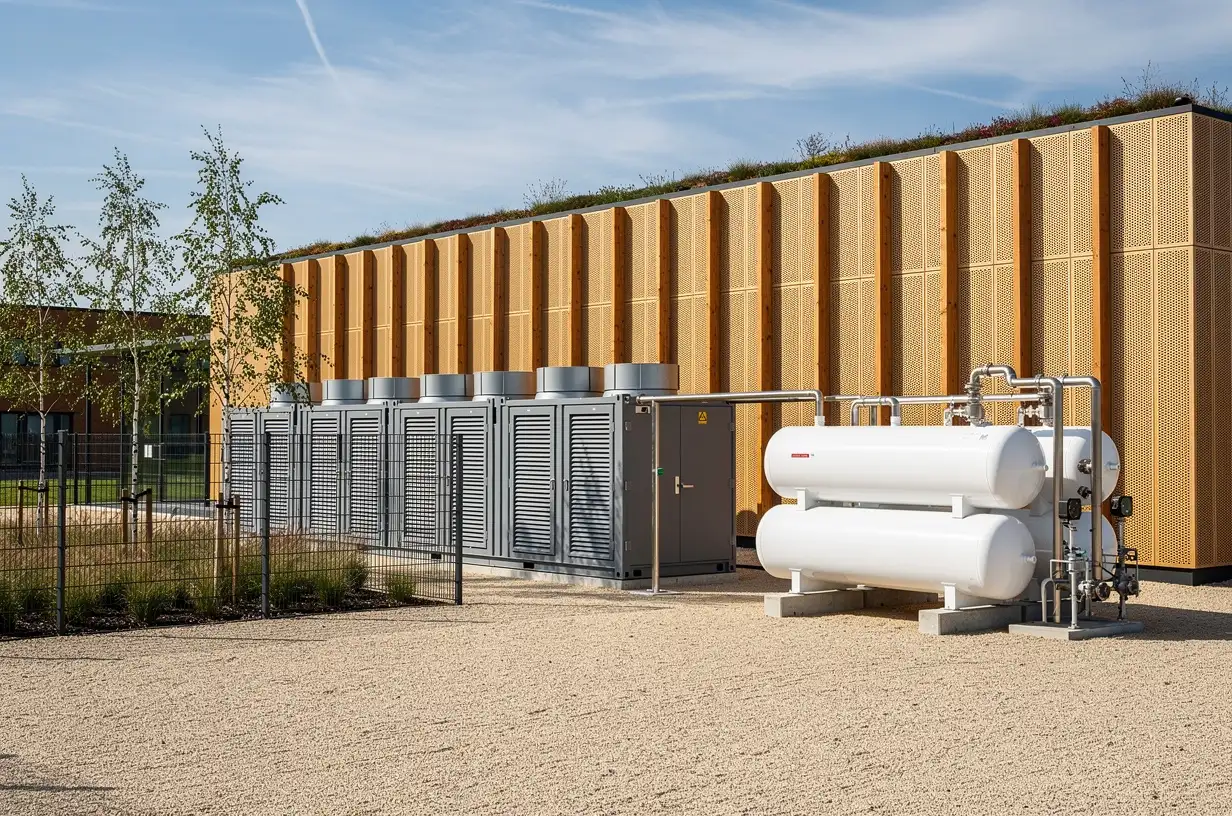
Hybrid configuration
Six elements, coordinated as one system.
BESS for immediate response
01Battery energy storage provides immediate response power, bridging the gap between a grid interruption and the activation of longer-duration backup.
Hydrogen PEM fuel cells for longer backup
02Hydrogen proton-exchange-membrane fuel cells are under evaluation to provide longer-duration backup power, producing zero-emission at the point of use along with captured heat that can be engineered for reuse.
Intelligent power management
03Monitoring and control systems coordinate battery storage, backup power and grid interaction in real time, so each layer activates only when it is needed.
Safe hydrogen storage and logistics
04Hydrogen storage and delivery are designed to recognised safety standards, with storage volumes, delivery frequency and site layout assessed per location.
Renewable-energy integration
05On-site and contracted renewable generation is integrated into the hybrid configuration alongside storage and backup power.
Useful application of heat
06Heat produced by fuel cells and other backup systems is engineered for reuse where a nearby off-taker exists, rather than dissipated.
Response timeline
How the layers respond, against the conventional reference.
Conceptual development model
Honest constraints
What is proven, and what is still under evaluation.
A hybrid configuration involving hydrogen fuel cells carries real, unresolved constraints. They are stated here rather than left implicit.
Permitting
01Hydrogen storage and fuel cell installations are subject to permitting requirements that vary by jurisdiction and site; permitting pathways are assessed per project, not assumed.
Logistics
02Hydrogen delivery, storage replenishment and site access for logistics are planned per location, and deployment depends on locally available hydrogen supply.
Reliability
03Fuel cell reliability at the scale and duty cycle relevant to a data center backup application is still being validated; PEM fuel cells remain under evaluation until that validation is complete.
Scalability
04Scaling hydrogen fuel cells to match the backup duration and capacity of a large development is not yet a solved problem industry-wide, and is treated as such in project planning.
Lifecycle carbon
05The lifecycle carbon impact of a hydrogen fuel cell system depends heavily on the origin of the hydrogen used; this is assessed per project and per hydrogen source, not assumed to be favorable by default.
Operator requirements
06Operating a hydrogen fuel cell system requires trained personnel and specific safety procedures beyond those of a conventional backup power system, planned into every project that evaluates the technology.
Nitrogen+ Design
Towards nitrogen-positive data center development.
Designed to minimise nitrogen emissions across construction and operation. The categories below are assessed per project; nitrogen-positive status is a design ambition, not a claim of current or achieved performance.
Nitrogen+ Design 10 CATEGORIES
Operational NOx
Emergency-power emissions
Avoided diesel-generator hours
Construction emissions
Construction traffic
Hydrogen origin
Local-air-quality impact
Nitrogen deposition
AERIUS calculations for Dutch projects
Independent verification
Categories only. Each one is defined per project, and no target value is published before it has been independently validated.
Next step